

|
Quantity
|
Total
|
||
|
|
|||
|
|
|||
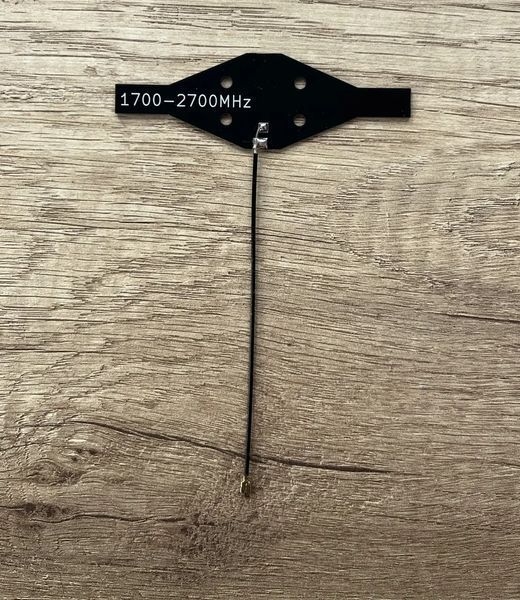
Wideband dipole receiving antenna for FPV drone control 1700–2700 MHz Aeronetix, 10 cm cable, IPEX1
Wideband dipole receiving antenna for FPV drone control 1700–2700 MHz Aeronetix, 10 cm cable, IPEX1 is designed for stable signal reception in a high-frequency wideband range. Support for 1.7–2.7 GHz allows the antenna to operate with control, telemetry, and video transmission systems, including 1.8, 2.0, and 2.4 GHz bands.
The dipole design ensures uniform omnidirectional reception without dependence on antenna orientation. Its compact size and very low weight make it ideal for lightweight and mobile platforms where minimizing load is critical.
We are a team of veterans
We work with communication systems in real-world conditions where signal stability is essential. We understand the importance of wideband antennas that maintain performance across changing frequency environments.
We select solutions based on real operational needs, frequency ranges, and conditions. Our approach focuses on delivering stable and reliable reception.
Technical specifications
| Parameter | Value |
|---|---|
| Type | Dipole receiving antenna |
| Frequency range | 1700–2700 MHz |
| Gain | ~2 dBi |
| Polarization | Linear |
| Dimensions | 110 × 16 × 1.5 mm |
| Weight | 6 g |
| Connector | IPEX1 |
| Cable length | 100 mm |
| Construction | Wideband |
| Application | Control signal reception |
| Manufacturer | Aeronetix |
Comment / comments
The wideband structure ensures stable operation across a broad frequency range without signal drop-offs. This is especially important for systems using frequency hopping or dynamic channel selection.
The lightweight and compact design makes the antenna ideal for platforms with strict weight constraints. The dipole geometry provides consistent reception without the need for precise alignment.
Who it is suitable for
Military
Suitable for control and communication systems where stable high-frequency reception is critical. Provides reliable signal in complex RF environments. Enables operation across varying frequency conditions. Used in mobile and stationary systems. Suitable for field deployment.
FPV operators and technical units
Suitable for receivers operating at 1.8, 2.0, and 2.4 GHz. Provides stable signal without complex setup. Allows operation across multiple frequency configurations. Used in various system setups. Suitable for daily use.
Engineers and system developers
Used for testing and developing communication systems. Enables operation across a wide frequency range. Suitable for lab and field testing. Ensures stable performance. Used in prototyping.
Control and telemetry systems
Suitable for receiving modules in various solutions. Provides stable signal when properly connected. Used in mobile systems. Enables operation in interference-heavy environments. Suitable for specialized applications.
Enthusiasts and professional users
Suitable for building versatile control systems. Enables operation across a wide high-frequency range. Provides stable results when properly configured. Used for testing and tuning. Offers flexibility in system design.