
|
Quantity
|
Total
|
||
|
|
|||
|
|
|||
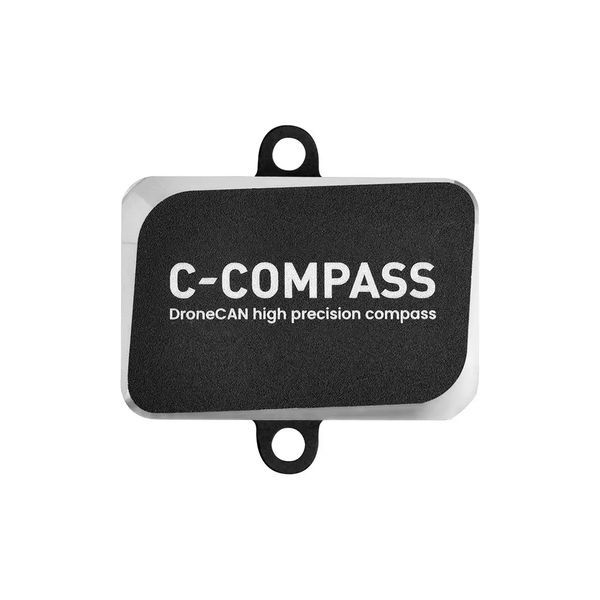
The CUAV C-Compass RM3100 airborne compass is a high-precision external magnetometer designed for integration with modern flight controllers operating on ArduPilot or PX4 firmware. The device is built around the advanced PNI RM3100 geomagnetic sensor, which utilizes magneto-inductive sensing technology to eliminate temperature drift issues and ensure a stable vehicle heading. The external design of the module allows the sensor to be positioned far away from power cables, electronic speed controllers, and motors that generate powerful electromagnetic interference on the internal compasses of flight controllers.
This module provides high resolution and a low noise floor when measuring the Earth's magnetic field, directly impacting the position-hold precision and navigation performance of autonomous platforms. Thanks to the communication protocol (or standard I2C interface depending on the selected wiring configuration), the compass guarantees high-speed data transmission and link resilience against interference. The module enclosure protects the internal electronics from mechanical damage and environmental factors during long-term operation in field conditions.
🫡 We Are a Team of Veterans
We know how often a compass failure or a "magnetic variance" error leads to the loss of a vehicle or its unpredictable behavior in the air during autonomous missions. Stock magnetometers soldered directly onto the flight controller board inevitably suffer from interference caused by high currents of the flight battery and the operation of the UAV power plant. We consider the CUAV C-Compass RM3100 an essential component for building reliable navigation systems for large reconnaissance and strike platforms. Mounting this sensor on a separate mast allows for complete isolation of navigation parameters from the influence of the UAV's internal systems, guaranteeing confident execution of waypoint flight missions even under heavy maneuvering conditions.
⚙️ Technical Specifications
| Parameter | Value |
| Model | CUAV C-Compass RM3100 |
| Magnetic Sensor | PNI RM3100 |
| Sensor Technology | Magneto-inductive |
| Connection Interface | I2C |
| Module Processor | STM32F4 / STM32G4 (depending on revision) |
| Measurement Resolution | up to 13 nT (nanotesla) |
| Data Refresh Rate | up to 150 Hz |
| Supply Voltage | 5V DC |
| Operating Temperature Range | −20°C to +65°C |
| Software Compatibility | ArduPilot, PX4 |
| Flight Controller Compatibility | CUAV V5+, Pixhawk 4, Pixhawk 5X, Pixhawk 6C and equivalents |
| Weight | 15 g |
Commentary / Comments
The key advantage of the CUAV C-Compass RM3100 lies in the use of magneto-inductive technology from PNI, which fundamentally differs from common, cheaper sensors like micro-electromechanical systems (MEMS). This sensor delivers a resolution of 13 nanoteslas, allowing it to register the slightest changes in the geomagnetic field without accumulating drift errors, eliminating the need for constant recalibration before every flight. The high data refresh rate of up to 150 Hz integrates seamlessly into the flight controller's Kalman filter algorithms, ensuring an instantaneous system response to heading changes.
Implementing the digital bus significantly increases system reliability, as this protocol is designed specifically for critical avionics components and is resilient against single-point failures. The low module weight of 15 grams adds no significant load to the airframe, allowing it to be placed on high, lightweight GPS masts to maximize distance from electromagnetic noise sources.