🔎 What is EBI?
EBI (Equivalent Background Illumination) is a measure of internal light noise in night vision devices (NVDs). It defines the minimum ambient light level required for the device to produce a usable image. Even in total darkness, the photocathode emits electrons, creating a baseline noise level. According to MIL-STD, the maximum acceptable EBI is 2.5.
EBI is calculated as the difference between the noise level under low light and the noise level in complete darkness. It reflects how much internal noise the device generates when no external light is present.
🌌 EBI in Astronomy
In astronomy, where observed objects emit almost no light, EBI becomes a critical factor. Any internal noise can completely mask the faint signal. Since no additional light can be introduced, the image is either visible or lost. If ambient light is below the EBI threshold, the image disappears into the noise.
Analogy: imagine an old radio with the volume turned down. You hear only static. If the signal (light) barely exceeds the noise (EBI), the music (image) is indistinguishable.
🪖 EBI in Ground-Based Use
In ground-based, head-mounted use, EBI has minimal impact. There is usually some ambient light — from the moon, streetlights, or IR illuminators. Tubes with EBI 1.6 perform just as well as those with 0.9 in most real-world scenarios.
If the light level is so low that EBI becomes noticeable, the image would be unusable anyway. In such cases, supplemental illumination is required.
📊 Analytical Context
- EBI as a sensitivity threshold: It defines the lowest light level at which the NVD can form an image. Below that, only noise remains.
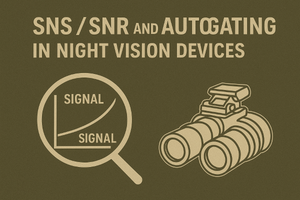
- EBI vs. SNR: Higher SNR (signal-to-noise ratio) often correlates with higher EBI due to increased thermionic activity in more sensitive photocathodes. A higher EBI is not necessarily a flaw — it’s a trade-off for better performance.
- Perceptual insignificance: The difference between EBI 0.9 and 1.6 is barely noticeable in practice. That’s why manufacturers don’t always match EBI values in dual-tube systems.
💡 Conclusions
- Lower EBI is better — but not always critical.
- In ground use, EBI has minimal effect on image quality.
- In astronomy or extreme low-light scenarios, EBI can be decisive.
- Higher SNR often comes with higher EBI — and that’s expected.
- Don’t judge a tube by EBI alone — SNR, FOM, resolution, and optics matter more.