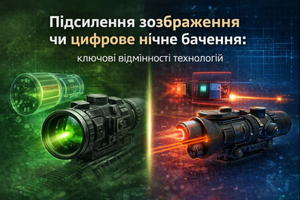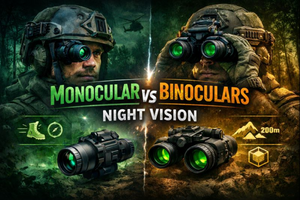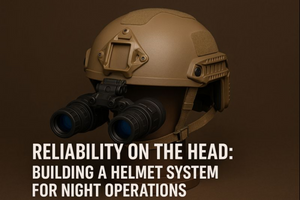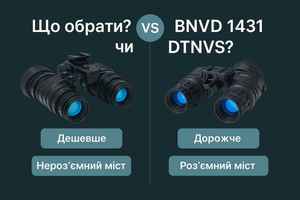
When mounting night vision on a helmet, your first major decision is deceptively simple: one tube or two? This choice determines your budget, comfort, field perception and how naturally you can move in the dark. Both options have clear benefits, and neither is universally better — the right answer depends entirely on your mission and environment.
Monocular: simplicity, versatility and adaptation
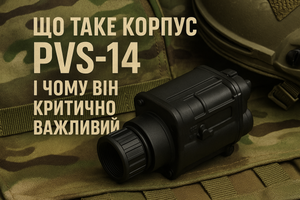
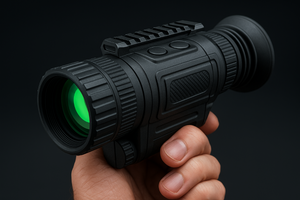
Monoculars — like the iconic PVS-14 — are where most users begin.
Key advantages:
-
only one eye is enclosed while the other stays naturally adapted;
-
the brain processes two different inputs, improving situational awareness;
-
ideal for mixed-light environments or transitions between dark and dimly lit areas;
-
lighter, simpler and far more affordable than dual-tubes.
A monocular is an effective and budget-friendly gateway into night vision.
Dual-tube systems: depth perception and natural movement
When both eyes receive the same intensified image, you gain true stereoscopic depth perception, similar to daytime vision.
Advantages include:
-
accurate distance estimation;
-
confident movement through uneven terrain;
-
improved performance in buildings, vehicles and confined spaces;
-
fewer mistakes at high speed.
The trade-offs — higher cost and weight — are compensated by improved safety and efficiency for demanding tasks.
Articulating binoculars: the hybrid solution
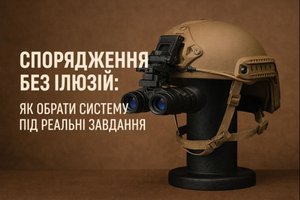
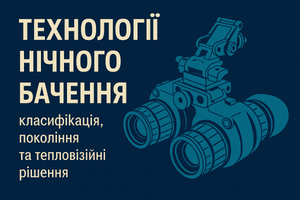
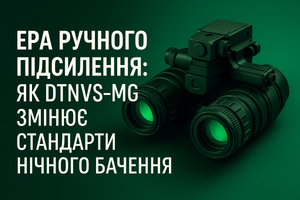
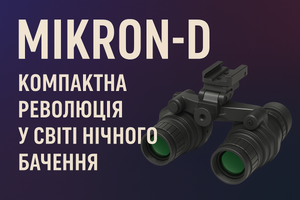
Modern dual-tube systems with articulating pods add another layer of flexibility.
Benefits:
-
Hybrid mode: flip one tube up for monocular-style use;
-
Low-profile stowage: folded tubes sit closer to the helmet;
-
Instant transition: raise both pods to return to natural vision.
This design combines the advantages of monocular and binocular systems in one platform.
Choosing the right system
Choose a monocular if:
-
you want an affordable, lightweight system;
-
you operate in mixed-lighting environments;
-
you need simplicity and adaptability;
-
you are entering night vision for the first time.
Choose dual-tubes if:
-
you move quickly in darkness;
-
terrain navigation is critical;
-
depth perception is essential;
-
you work in vehicles or structures.
Conclusion
A monocular offers accessibility and flexibility.
A dual-tube system provides speed, spatial accuracy and maximum performance.
Articulating tubes deliver the best of both worlds.
Your environment and objectives should determine your choice — not the trend.