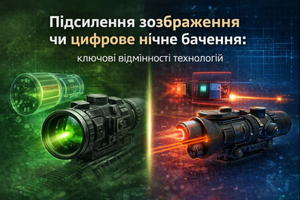
Analog night-vision devices (NVDs) have a naturally limited depth of field. Once the focus point is set, only a certain distance range remains sharp, while objects closer or farther become blurred. This is not a flaw — it is an inherent property of the optical system.
1. Why depth of field is limited
An analog NVD focuses in a single plane. If the user focuses on a distant target, near objects appear blurry, and vice versa — exactly like the human eye.
2. How reduced-aperture devices work
An aperture reducer limits the amount of light reaching the lens, which leads to:
-
Increased depth of field — more objects at different distances stay acceptably sharp;
-
Decreased image brightness — less light results in a darker, noisier image.
3. When an aperture is genuinely useful
Aperture devices are valuable when:
-
there is ambient illumination (urban conditions, starlight, moonlight);
-
the user must see near and far objects simultaneously (driving, patrol work);
-
performing administrative or search tasks.
In total darkness they are less effective due to light loss.
4. Practical ways to increase depth of field
-
standard day caps with small holes;
-
MATBOCK Tarsier Eclipse — fully adjustable aperture with sacrificial window;
-
Phokus Hoplite — fixed-aperture flip cover;
-
improvised scope caps with drilled openings (cheap but imprecise).
5. How to decide whether you need an aperture
Ask yourself:
-
Do you often need both near and far objects to be in focus?
-
Will you operate in environments with enough light?
-
Do you need additional lens protection?
-
Do you want smooth, adjustable aperture control?
6. A simple pre-purchase test
Use an inexpensive scope cap with a small hole.
If the improvement suits your needs — invest in a proper dedicated device.