Accessories for Drones: What You Should Know After Choosing the Main Platform
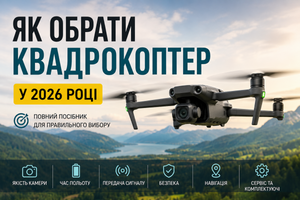
In the previous article “How to Choose a Drone in 2026: A Complete Guide to Making the Right Choice”, we reviewed the key criteria for selecting a platform: endurance, camera quality, stabilization systems, flight range, signal transmission, and the overall logic of choosing equipment for specific tasks.
However, once the drone itself is selected, the next important stage begins — choosing the right accessories. In real-world operation, accessories often determine how effective the entire system will be.
Connection stability, component lifespan, video link quality, connection reliability, long-distance operation, and performance in difficult terrain all depend not only on the drone itself but also on the components used with it.
In this article, we will briefly review the main groups of drone accessories. Each category can later be explored in more detail in separate articles.
Why accessories are no less important than the drone itself
Many users think that once they buy a drone, the main task is already completed. In reality, this is only the beginning. In practical use, accessories often determine how convenient, stable, and safe the whole system will be.
For example, quality propellers affect flight stability and energy efficiency. Antennas define connection quality. Cables, connectors, and adapters are responsible for reliable communication between components. Filters improve image quality. Transmitters and receivers create the foundation of the control channel.
Accessories should not be treated as secondary details. In many cases, they are what unlock the full potential of the primary equipment.
Summary: the right accessories improve stability, convenience, and the lifespan of the drone. That is why they should always be chosen based on real tasks and operating conditions.
Propellers
Propellers are among the most important consumable parts of a drone. They directly affect thrust, flight stability, noise level, energy consumption, and overall efficiency.
Even minor blade damage can reduce aerodynamic efficiency. As a result, motors work under heavier load, batteries drain faster, and flight stability decreases.
Propellers should be inspected regularly after transportation, hard landings, or operation in difficult conditions. It is also important to use models compatible with your specific platform.
Summary: functional propellers are not only a matter of efficiency but also of safety. Keeping spare sets available is always recommended.
Video Link Antennas
The video link is responsible for transmitting the image from the drone to the operator. If the signal is unstable, users may experience delays, interference, image quality loss, or temporary blackouts.
Video antennas improve transmission stability, especially at long range or in difficult terrain. They differ by frequency, polarization, shape, gain, and connection type.
The correct choice depends on the system, operating conditions, and required distance.
Summary: if your image feed is unstable or often affected by interference, the first thing to consider is upgrading the video antennas.
Control Antennas
Control antennas determine the quality of the connection between the operator and the drone. They affect command stability, operational range, and the predictability of system behavior.
A standard antenna may not always deliver the required result in difficult environments. If signal quality drops or connection losses appear, replacing the antenna can be one of the most effective upgrades.
Omnidirectional antennas are usually suitable for universal use, while directional antennas are often used for focused long-range operation.
Summary: control antennas are one of the most critical elements of the communication system. Choosing the right one can significantly improve stability.
Relay Antennas
Relays are used where signal coverage needs to be expanded or stabilized in difficult conditions. In such systems, antennas play a particularly important role.
They help shape the direction of signal transmission, reduce losses, and improve overall system efficiency. Without the right antenna, a relay cannot fully reach its potential.
Summary: for relay systems, the antenna is just as important as the relay hardware itself.
Transmitters
The transmitter creates the signal sent from the operator to the drone. It forms the basis of the control channel and works together with the antenna and receiver.
A quality transmitter provides stable performance, fast response to commands, and better predictability. However, even the best transmitter depends on the right antenna and receiver.
Summary: the transmitter is the central part of the control system, but its performance depends directly on compatibility with other components.
Receivers
The receiver is installed onboard the drone and is responsible for receiving commands from the transmitter. Its quality directly affects the stability of the control system.
Even if the transmitter and antenna are chosen correctly, a weak or incompatible receiver can limit the system’s capabilities.
Summary: the receiver is a critical part of the control system and should never be selected randomly.
Connectors
Connectors may seem like small details, but they are responsible for physical reliability. An unstable connection can lead to signal loss, power interruptions, or unexpected component failures.
It is important to consider connector type, build quality, compatibility, and the operating environment.
Summary: quality connectors ensure stable contact and reduce the risk of unexpected failures.
Cables and Cable Assemblies
Cables transfer signal or power between system components. They must be flexible, reliable, and compatible with the equipment being used.
Cable assemblies are useful when a ready-made solution is needed without extra installation work.
Summary: cables directly affect connection reliability and should never be selected as an afterthought.
Adapters
Adapters allow components with different connection types to work together. They help make systems compatible without replacing equipment.
However, adapters must be high quality. Poor adapters can create signal loss, unstable contact, or mechanical issues.
Summary: adapters can be useful but should never become the weak point of the system.
Filters
Filters improve image quality and light control. They are especially useful during daylight shooting, in open areas, or under changing light conditions.
The right filter helps create more natural footage, avoid overexposure, and better control shutter speed.
Summary: filters are essential for users who want better image quality without heavy post-processing.
Masts
Masts are used to place antennas or equipment at higher elevation. This can improve signal transmission and reception, especially in difficult terrain or areas with obstacles.
A higher antenna position often reduces interference and improves overall connection quality.
Summary: masts can significantly improve antenna system performance, especially in complex environments.
Signal Boosters
Signal boosters are used when signal transmission or reception needs to be improved within a specific system. They can be useful in difficult conditions but must be chosen carefully.
It is important to understand that a booster does not replace a quality antenna, proper cable, or compatible receiver. It works only as part of a complete system.
Summary: a signal booster should be seen as part of a complete solution, not as a universal fix for every connection issue.
Conclusion
Drone accessories directly affect efficiency, stability, and convenience. Propellers define flight quality, antennas handle communication, transmitters and receivers form the control link, while cables, connectors, and adapters ensure reliable system integration.
Filters improve image quality, masts can raise antenna systems to more effective positions, and signal boosters can enhance communication stability as part of a complete solution.
In future articles, each of these categories can be explored in greater detail. But even now, one thing is clear: properly chosen accessories do not simply complement a drone — they make the entire system significantly more reliable and effective.
Summary: if the drone is the foundation of the system, accessories determine how well that system performs in real-world conditions.