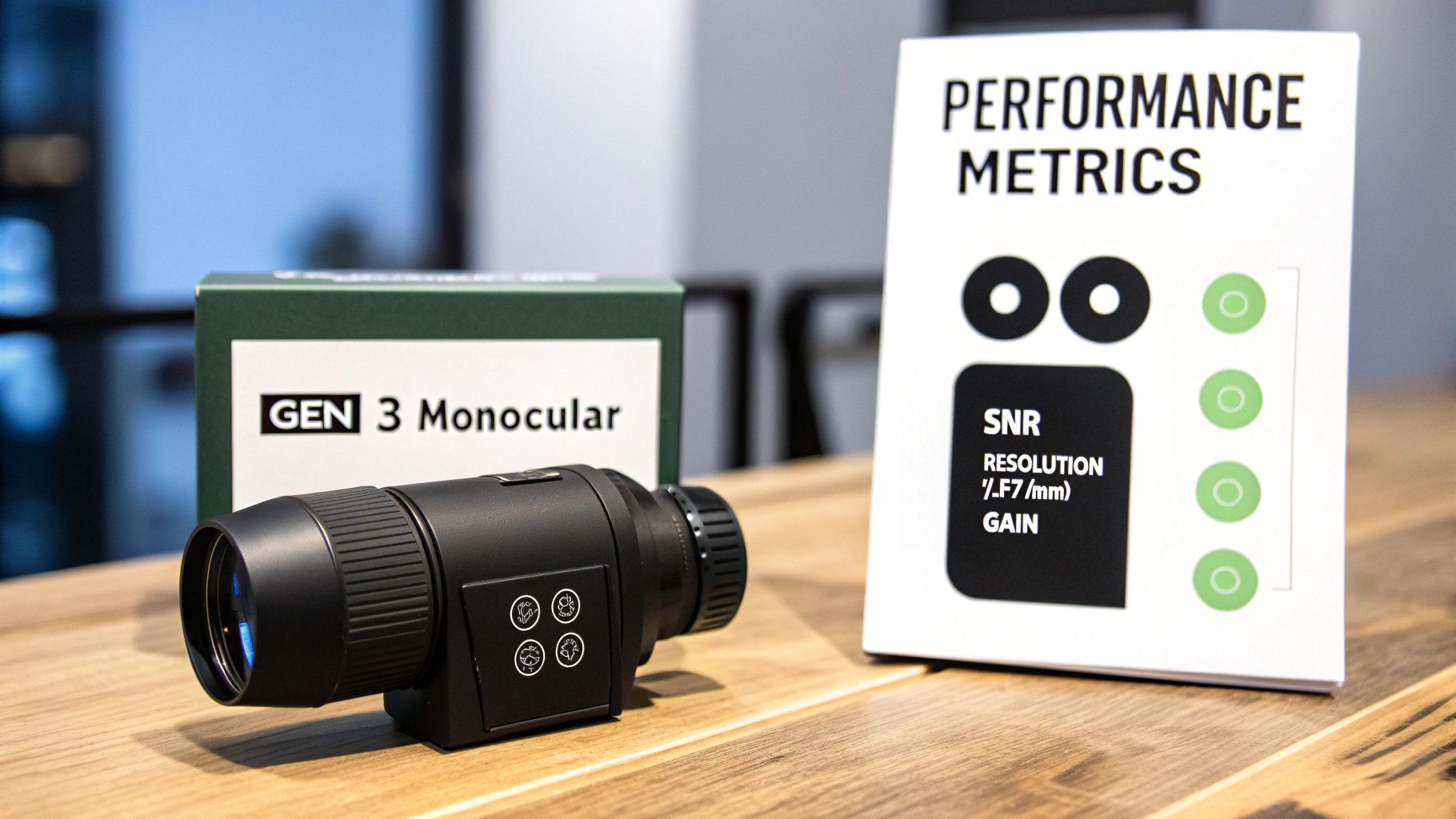
Third-generation night-vision devices have long been the benchmark against which all other technologies are measured. When military units, law-enforcement officers or serious civilian users talk about “real” night vision, they almost always mean Gen 3. The reason is simple: it combines sensitivity, image clarity, service life and reliability in a way that is still hard to beat.
1. The leap from early generations to Gen 3
First- and second-generation devices made it possible to see in the dark, but with significant limitations: distorted imagery, heavy grain, dependence on strong IR illuminators and relatively short tube life.
Gen 3 marked a fundamentally new stage. In practice it feels like moving from an old CCTV feed to a modern HD picture: the same scene, but the difference in detail and cleanliness is dramatic.
2. The role of the gallium-arsenide photocathode
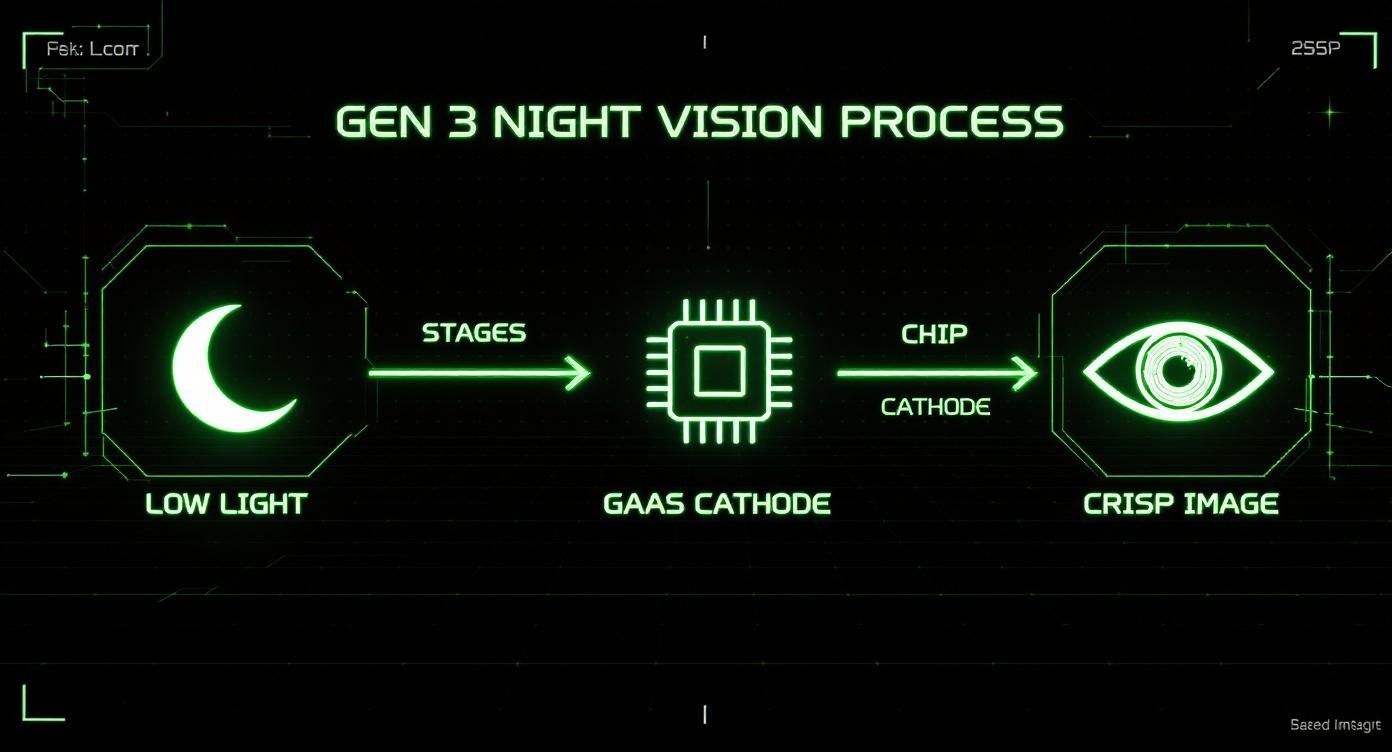
The key breakthrough was the use of a gallium-arsenide (GaAs) photocathode. This layer converts photons of faint starlight or moonlight into electrons. GaAs does this far more efficiently than earlier materials, so even a tiny amount of light produces a strong electronic signal.
As a result, third-generation goggles:
-
produce a bright image where Gen 1/2 devices are already “blind”;
-
depend less on external IR light and therefore are less likely to reveal the user’s position.
3. The microchannel plate and signal amplification
After the photocathode, electrons enter the microchannel plate (MCP) — a thin disc filled with millions of microscopic channels. Inside each channel the electrons bounce off the walls many times, creating a cascade of secondary electrons. This multiplies the original signal tens of thousands of times while preserving the structure of the image.
It is the combination of the GaAs photocathode and the MCP that makes Gen 3 devices so sensitive and precise.
4. Why Gen 3 imagery looks “different”
Three key parameters define image quality:
-
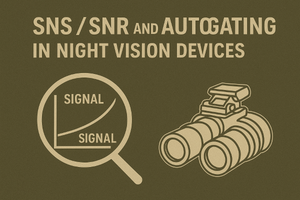
Signal-to-noise ratio (SNR). Indicates how clean the image will be under extremely low light. A higher SNR means less grain and more useful detail in the dark.
-
Resolution (lp/mm). Shows how fine the details can be resolved. Gen 3 offers significantly higher resolution than earlier generations.
-
Gain. Tells how many times the incoming light is amplified. Gen 3 has very high gain, but crucially it maintains a good SNR, so the image does not turn into bright “snow”.
In real use this means that third-generation devices deliver cleaner, more contrasty and more informative images exactly when light is scarcest.
5. Tube life and reliability
Another reason Gen 3 became the “gold standard” is its real-world service life. Quality third-generation tubes are rated for many thousands of hours of operation. For the user this translates into years — even decades — of service if the device is treated correctly.
Combined with rugged military-grade housings, this turns the system into a dependable tool rather than a disposable gadget.
6. Why Gen 3 is still relevant despite “Gen 4” claims
From time to time, devices advertised as “4th generation” appear on the market. It is important to understand that officially these are still advanced Gen 3 tubes (for example, filmless designs), and “Gen 4” is essentially a marketing label.
Such tubes can indeed deliver even better SNR and clarity, but the underlying architecture remains the same: GaAs photocathode, microchannel plate and phosphor screen. The foundation that made Gen 3 the standard is still there.
7. Conclusion: why Gen 3 is the benchmark
Third generation became the “gold standard” of night vision because it brought together several critical advantages in a single package:
-
very high light sensitivity thanks to the gallium-arsenide photocathode;
-
clean, detailed imagery under minimal illumination;
-
long tube life and military-grade reliability;
-
a proven architecture that still underpins today’s high-end systems.
That is why, when people speak about truly professional night vision today, third-generation goggles remain the primary point of reference.